

Stay Inspired
Subscribe for exclusive tips and storage ideas to elevate your kitchen.


This CIASSTHREE bias binder presser foot is a specialised sewing attachment designed to aid in the application of bias binding tape to fabric edges. It offers a mechanical solution for a task that can be challenging to perform neatly by hand or with a standard presser foot. The foot's primary function is to guide and wrap bias tape—whether pre-folded or flat—around the raw edge of your fabric as you sew, creating a clean, professional-looking finish. This method is particularly valued in garment construction, especially for reversible items where both sides of the fabric are visible, and for creating decorative elements like frog closures and button loops. Its compatibility is specific to modern household sewing machines that utilise a snap-on presser foot system.
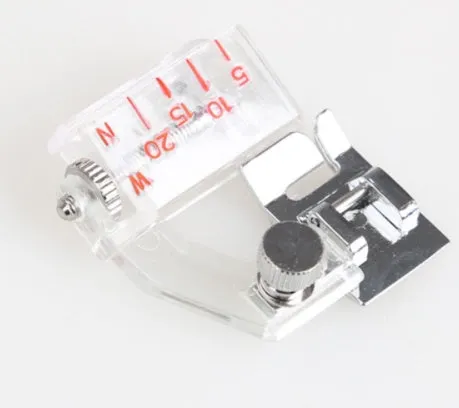
This presser foot is built to perform a specific function with clarity and simplicity. Its design focuses on the practical mechanics of applying bias tape, avoiding unnecessary complexity. The construction details provided define its capabilities and limits.
The CIASSTHREE bias binder foot is manufactured from a combination of plastic and alloy materials. The plastic likely forms the main body and the cone guide, while the alloy provides the structural base and snap-on mechanism for secure attachment to the sewing machine. This material choice results in a lightweight yet functional attachment. The foot's design centres on a cone feature, which is the core working component that physically wraps the bias tape around the fabric edge during the sewing process.
The foot has compact dimensions, measuring approximately 4.4 cm in length by 3.6 cm in width. This size is standard for many household sewing machine presser feet. Its key fitting requirement is a snap-on attachment system. It is confirmed to be compatible with household sewing machines from common brands such as Brother and SINGER that use this type of foot mechanism. A crucial limitation is its incompatibility with three categories of machines: old models that may use different fittings, mini sewing machines, and industrial sewing machines, which have entirely different attachment standards.

The application of this foot is focused on specific sewing techniques where a bound edge is desired. It turns a multi-step manual process into a more streamlined operation performed directly on the sewing machine.
For sewers creating reversible garments, where both the interior and exterior fabrics are meant to be seen, this foot provides a neat method for finishing seams and edges without visible raw edges or bulky hems. It is also a practical tool for making consistent, uniform frog closures (decorative knotted fasteners), button loops, and fabric ties, which are common in both historical costume reproduction and certain styles of contemporary clothing. The adjustable nature of the binding process allows for control over the tightness of the wrap.
In a home sewing context, this attachment simplifies adding a decorative or reinforcing trim to the edges of items like table linens, napkins, quilts, or simple apparel. It helps achieve a consistent finished width on the bias tape, which can be difficult to maintain manually. The foot can handle both pre-folded bias tape, which is ready to use, and single-fold or flat tape, offering flexibility depending on the sewer's available supplies and desired finish.
The value of this product lies in its targeted functionality and the practical sewing challenges it addresses directly, based on its stated design.
As a durable sewing machine attachment made from plastic and alloy, it is designed for repeated use across multiple projects once acquired. Maintenance is minimal; it requires only occasional cleaning to remove lint and thread fragments to ensure the cone mechanism moves freely. Its value is realised over time through its reuse on various sewing projects requiring edge finishing with bias tape.
You would choose the CIASSTHREE bias binder foot if you frequently finish garment or project edges with bias tape and seek a tool to increase consistency and speed. Its clear benefit is the dedicated cone mechanism that physically manages the tape-wrapping process. The primary differentiator is its specific compatibility with snap-on systems on common household brands like Brother and SINGER, coupled with its explicit incompatibility with old, mini, or industrial machines, which helps ensure a correct purchase. It offers a single, focused solution for a common sewing technique.